
Harnessing the Integrated Statistical Machine Learning for Traffic Crash Injury-Severity Modeling
Published in Reliability Engineering & System Safety, 2026
Authors
Pengfei Cui, Chenzhu Wang, Mohamed Abdel-Aty, Xiaobao Yang*, Xingchen Zhang, Lishan Sun
Abstract
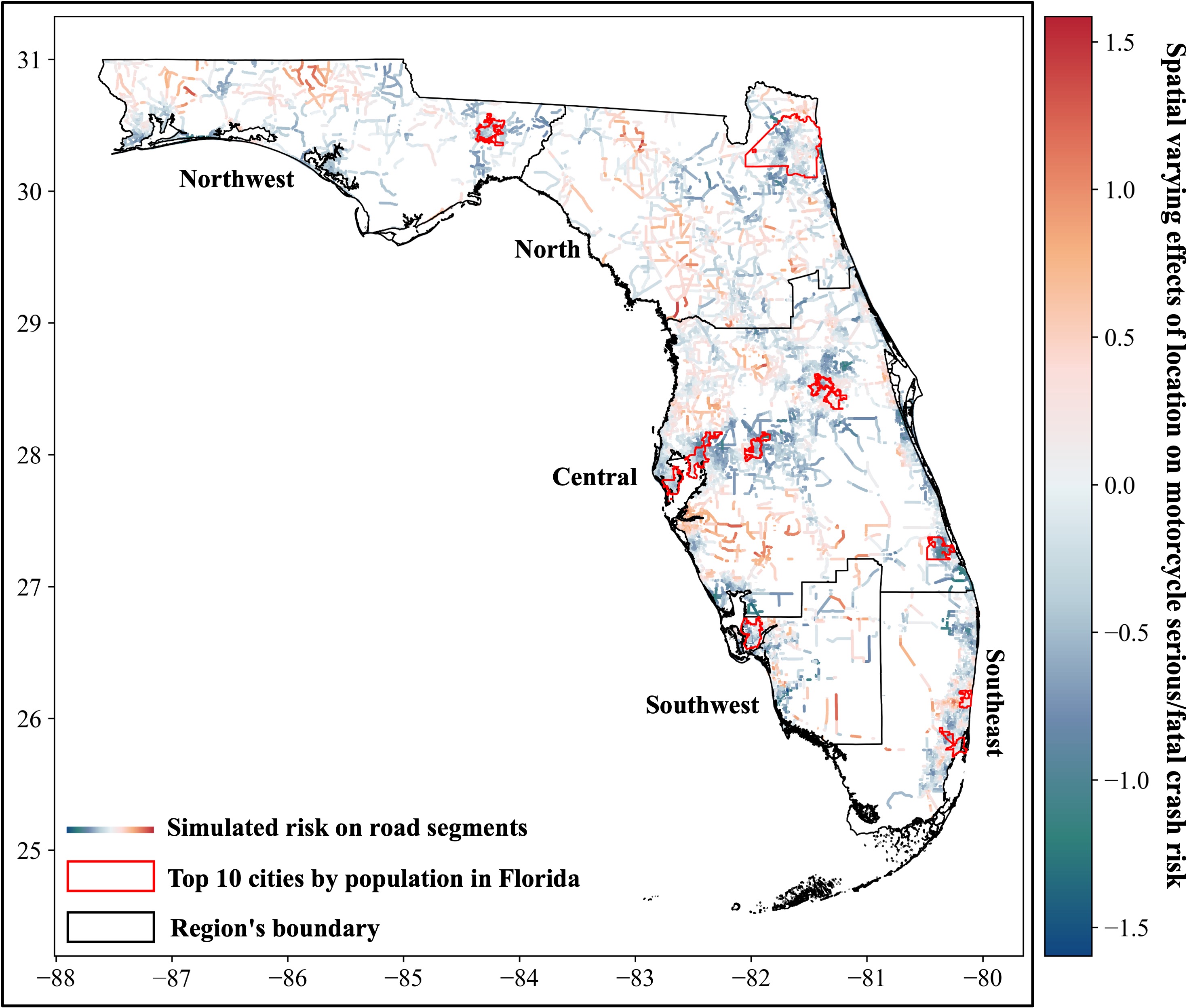
Modeling the severity of traffic crash remains challenging due to the complexity, uncertainty, and heterogeneity inherent in crash datasets. Traditional statistical models often overlook interactions and structural dependencies, while machine learning methods, though effective with large datasets, struggle to capture spatial and temporal dynamics. To address these gaps, we propose the Latent Gaussian Process with Tree-Boosting Model (LGPBoost), which integrates tree-based machine learning with Gaussian process mixed effects models. This framework accounts for spatial, temporal, and grouped dependencies while capturing nonlinear feature–outcome relationships. To demonstrate the superiority of LGPBoost, we conducted a well-designed simulation experiment focused on datasets characterized by complex feature relationships and latent grouped random effects, as well as spatial and temporal variabilities. Applying the method to Florida motorcycle crashes (2014–2023) revealed that rural and less urbanized areas face significantly higher severe and fatal crash risks, underscoring the need for targeted enforcement and infrastructure improvements. Temporal instability analysis further showed evolving crash risks across regions, particularly in non-urban regions. By unifying spatial heterogeneity and temporal variability, LGPBoost provides a rigorous benchmark for reliability-oriented crash severity modeling, offering a comprehensive framework to identify risk factors, quantify non-linear effects, and capture intrinsic spatial-temporal dynamics.
Recommended citation: Cui, P., Wang, C., Abdel-Aty, M., Yang, X., Zhang, X., & Sun, L. (2026). Harnessing the integrated statistical machine learning for traffic crash injury-severity modeling. Reliability Engineering & System Safety, 273, 112321. https://doi.org/10.1016/j.ress.2026.112321
Download Paper